
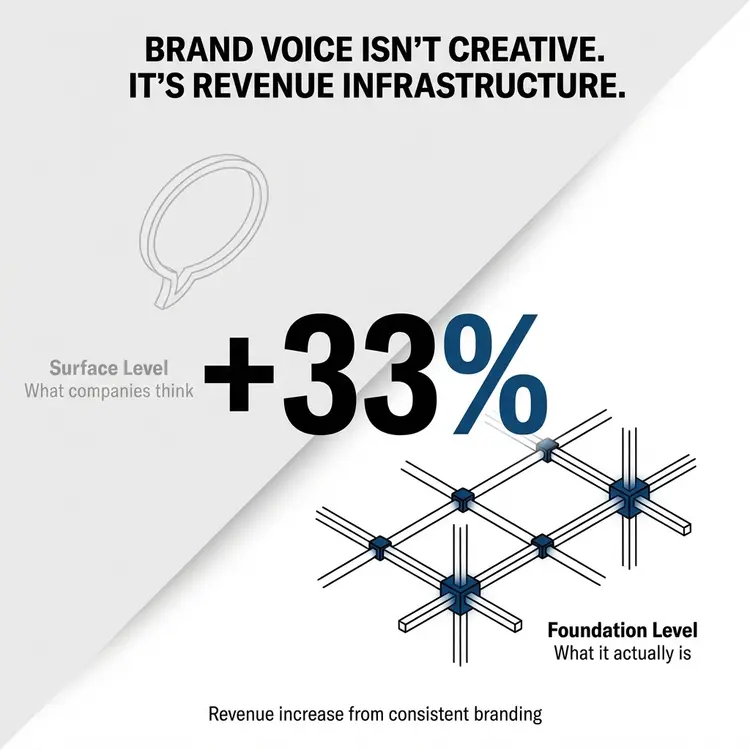
Most companies treat brand voice as a creative decision. Something the marketing team workshops in a conference room, documents in a slide deck, and files away.
That’s the problem.
Brand voice isn’t a creative asset. It’s revenue infrastructure.
When your brand voice lacks definition, consumers lose confidence in your ability to deliver. They can’t figure out what you stand for or whether you’ll consistently show up the way you promise.
Beyond customer confidence, undefined voice creates an internal tax on every piece of content you produce. Your teams spend 2-3x longer in ideation and asset creation because they’re redefining your brand with every campaign, email, and landing page.
The math is brutal. Companies with brand consistency issues leave money on the table. Research shows that consistent branding can increase revenue by 33%. That’s not a marginal improvement. That’s the difference between struggling and scaling.
The Hidden Cost of Voice Improvisation
Here’s what happens when you don’t document your brand voice.
Each time your team creates assets, they start from scratch. They debate tone. They question messaging pillars. They second-guess word choice.
This process lengthens your ideation and creation phase by 2-3x. You’re burning time and budget on internal alignment that should have been solved once and documented.
But here’s the worse part.
Even with all that extra effort, you still end up with off-brand content.
Why? Because without a clearly defined brand voice document, each creative team, individual, or project strays from your core messaging pillars. 81% of companies deal with off-brand content, even though over 60% believe maintaining consistency matters for lead generation and customer communication.
You have different teams interpreting your brand differently every single time.
The Conversion Disconnect
When off-brand content goes out into the market, it creates friction at every customer touchpoint.
A social media ad might draw someone in with sharp, confident messaging. They click through expecting that same energy. Instead, they land on a page that sounds corporate, cautious, or completely different.
The disconnect kills conversion.
You get good click-through rates but poor conversion rates. You’re paying for clicks that don’t convert. You’re burning budget on traffic that bounces because the handoff between touchpoints isn’t aligned.
Most people blame the landing page design or the offer. The root cause runs deeper.
It’s not just about voice misalignment between two touchpoints. It’s the total cumulative effect of communication your company makes to leads, customers, and the general public. The misalignment of touchpoints is just one manifestation of lacking a defined brand voice.
Research confirms this. When customers receive conflicting messages about your brand, it creates cognitive dissonance that forces them to work harder to understand your value proposition. In an attention-scarce environment, that additional mental effort results in prospects moving on to competitors who present clearer, more consistent messaging.
Brand Voice as Infrastructure
Brand voice needs to function as a foundational system that affects everything downstream.
Not just ad-to-landing page alignment. Sales calls. Customer support interactions. Internal communications. Product descriptions. Email sequences. Social media responses.
All of it.
When you finally document your voice and get everyone aligned, the first place you see measurable improvement is the awareness stage.
Why the awareness stage?
Because people can quickly understand the value your company or products will bring to their lives. Consistent voice acts as a clarity accelerator. People “get it” faster.
This clarity creates momentum. 73% of customers use multiple channels before buying. When your voice stays consistent across those touchpoints, each exposure reinforces the previous one instead of creating confusion.
Building Voice Documentation That Actually Works
Most brand voice guides sit on a shelf. They look pretty but don’t function.
Here’s what needs to be captured to make voice documentation functional across teams and platforms.
1. Tone Parameters
Define whether your voice is friendly, edgy, authoritative, playful, or technical. Be specific. “Professional but approachable” means nothing. “We explain complex processes in plain language without talking down to our audience” means something.
2. Unique Value Proposition
Document what makes your service or product unique. This filters into every message you create. Your voice should reflect this differentiation, not just describe it.
3. Visual Alignment
Your voice needs to match your visual identity. Classic, luxury, modern, minimal—these aren’t just design choices. They inform word selection, sentence structure, and content rhythm.
4. Customer Interaction Standards
Customer experience needs consistency across all forms of communication. From advertising through sales to post-sales support. Document how your voice adapts across these contexts while maintaining core identity.
Following documentation, you need enforcement. 95% of organizations have branding guidelines, but only one-fourth have formal guidelines that are consistently enforced. Over 60% report that materials are created that don’t conform to brand guidelines.
Documentation without enforcement is decoration.
The Competitive Advantage of Voice Differentiation
In commoditized markets where multiple companies offer essentially the same product or service, distinctive voice creates separation.
You’re not competing on features anymore. You’re competing on recognition and trust.
A well-defined brand voice attracts the right customers and repels the wrong ones. You’re speaking to your customer in a way that feels unique and demonstrates you understand them from a holistic perspective.
This isn’t about being clever or creative for creativity’s sake. It’s about building a repeatable system that converts recognition into revenue.
Companies that master consistency across 5+ channels see 400% better performance. Each additional consistent channel adds 90% to purchase probability. The multiplier effect compounds with every aligned touchpoint.
The Revenue Impact Is Measurable
Brand voice consistency directly affects your bottom line through three mechanisms.
Reduced Customer Acquisition Cost
When your voice creates clarity instead of confusion, you spend less to acquire each customer. Inconsistent voice forces you to spend more to compensate for the confusion you’re creating across touchpoints.
Increased Conversion Rates
Aligned messaging between awareness, consideration, and decision stages reduces friction. People move through your funnel faster because they’re not stopping to reconcile conflicting messages about who you are.
Higher Customer Lifetime Value
Consistent voice builds trust. Trust drives retention. Customers who trust your brand buy more frequently and refer others more often.
The greatest negative impact of inconsistent brand usage is market confusion, reported by 71% of study participants. Inconsistent messaging makes your organization appear disorganized or unreliable.
If you can’t maintain consistent communication about your own identity and values, customers question your ability to deliver consistent products or services.
Implementation Framework
Building voice as infrastructure follows a sequential process.
Phase 1: Audit Current Voice
Collect samples of all customer-facing content. Website copy, social posts, email campaigns, sales materials, support documentation. Identify where voice stays consistent and where it diverges.
Phase 2: Document Standards
Create guidelines that specify tone, vocabulary, sentence structure, and adaptation rules for different contexts. Include examples of what to do and what to avoid. Make it concrete enough that someone new to your team can apply it immediately.
Phase 3: Train Teams
Voice documentation only works when teams understand how to use it. Run workshops. Create templates. Build approval processes that catch inconsistencies before content goes live.
Phase 4: Monitor Consistency
Track voice adherence across all customer-facing content. Measure the correlation between voice consistency and conversion rates, customer acquisition cost, and retention metrics.
This is where most companies fail. They create the documentation but skip enforcement and measurement.
Moving Forward
Your brand voice either builds revenue or bleeds it.
Every inconsistent message costs you customer confidence, conversion opportunity, and competitive advantage.
The companies winning in crowded markets aren’t the ones with the biggest budgets or the flashiest campaigns. They’re the ones who built voice as infrastructure and maintained it with discipline.
You can keep treating brand voice as a creative exercise that gets revisited every time you launch something new. Or you can document it once, enforce it consistently, and watch it compound returns across every customer touchpoint.
The difference shows up in your revenue.